CargoSoft API (2026.1)
Attention: Since our API is still under development, endpoints may well change, or object structures may change. Of course, we try to avoid this as much as possible, but we cannot guarantee it. So that you have the possibility to react in time, we will soon offer you a possibility to subscribe to a newsletter. We would then inform all subscribers when something will change in the API. We are currently still looking for an integrable solution for newsletters, which can be used to subscribe and unsubscribe at this place. Until then, we would like to ask you to send us an email to support@cargosoft.de with the request that we inform you when there are planned changes to the API.
This page documents all business-relevant changes to our API.
| Category | Endpoint / Area | Change | Impact and required action | Version |
|---|---|---|---|---|
| Added | POST /cargosoft/shipment | Added new shipment create endpoint. | No changes to existing integrations are required. | 2026.1 |
| Added | Use cases | Added new use case to create a shipment - see | No changes to existing integrations are required. | 2026.1 |
| Added | Basic data | Added new edi code conversion endpoints. | No changes to existing integrations are required. | 2026.1 |
| Added | E-File | Added new E-File endpoints. | No changes to existing integrations are required. | 2026.1 |
| Deprecated | ShipmentEventQualifier | The shipment event qualifer TRANSSHIPMENT is now deprecated and will be removed in a future version. | Use the TRANSSHIPMENT_ARRIVAL shipment event qualifer instead. | 2026.1 |
| Category | Meaning |
|---|---|
| Breaking change | A non-backward-compatible change that may require integration updates |
| Added | A new feature, endpoint, field, or supported value |
| Changed | A backward-compatible change to existing behavior |
| Deprecated | A feature is still available but will be removed in the future |
| Removed | A feature, endpoint, or field has been removed |
| Fixed | A bug fix without an intended breaking interface change |
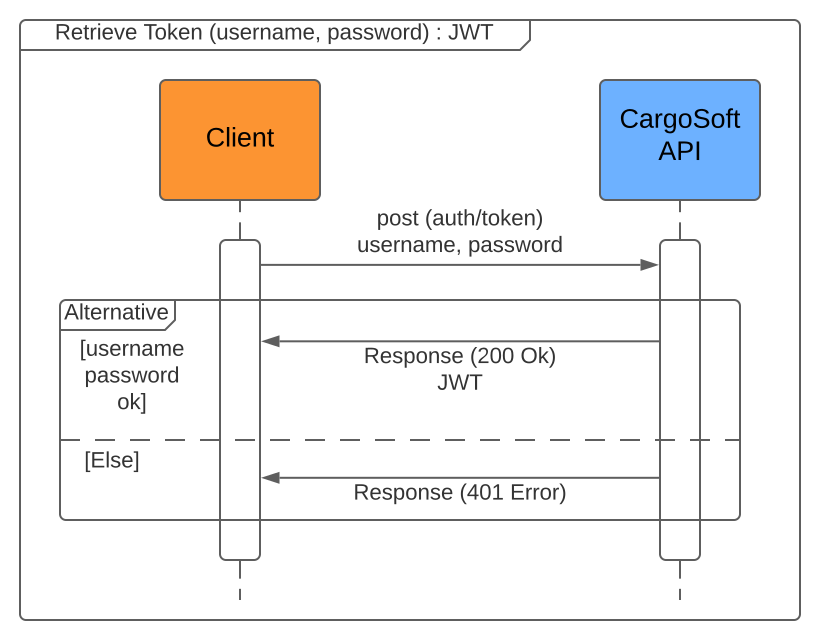
First of all each client has to request a bearer Java Web Toke (JWT) from the CargoSoft API. To receive a JWT, username and password are required. Username and password can only be created by CargoSoft. For more details see.
Please note: The JWT is valid for 24 hours. After that you have to request a new one.
To access the CargoSoft API endpoint, a JWT is required. The JWT has to be sent in the HTTP authorization header.
Example: This example shows a minimal curl with a bearer authorization header. The token is not valid because we only want to illustrate the structure.
curl --location --request POST 'https://api-demo.cargosoft.de/cargosoft/shipment/lookup' \
--header 'Authorization: Bearer eyJ0eXAiOiJqd3QiLCJhbGciOiJSUzI1NiJ9.eyJzdWIiOiJ1cGRhdGUiLCJjYXJnb3NvZnQtand0LNjc2NDQ1NTAzfQ.mK82rjSu0ltd0bf3mvXUqwpME05ck5OEuqnzsAQ8WPFPo' \
--data-raw '[]'"
Attention: Your user may be restricted. The CargoSoft API uses a permission system to grant access to the CargoSoft API endpoint. If your user is restricted or it's not allowed to use an endpoint you need please contact our support.
The webhook uses basic auth as its authorization type.
Example: This example shows a minimal curl request, to access the webhook. The basic auth is not valid.
curl --location --request POST 'https://api-demo.cargosoft.de/external/webhook' \
--header 'Authorization: Basic cG9ydg53xcvgawawb3J0YmFzZWNj' \
--data-raw '{}'"
Please note: Your user needs a special role to access the webhook endpoint via basic auth.
The CargoSoft API extends the CRUD retrieve operations with lookup operations. Each functional group of endpoints should have a lookup method implemented. Lookups should be used to search functional objects with given criteria named identifiers. The identifiers may be different to each functional group. To find out which functional identifier are possible, please take a look at the corresponding functional group.
The identifier will be sent in the request body to the API lookup endpoint. An identifier contains the following three information:
- match_mode: The match mode can alter the behaviour, how the criteria is compared against the object in the database are [EQUALS, CONTAINS, IN, OR, GT, LT, GE, LE].
- key: The key of the criteria for the functional object to lookup. To find out which keys are possible, please check the corresponding implementation.
- value: The value of the criteria.
Example: Lookup request body to search a shipment
[
  {
    "match_mode": "EQUALS",
    "key": "MBL",
    "value": "MASTER_12345"
  },
  {
    "match_mode": "EQUALS",
    "key": "MODE_OF_TRANSPORT",
    "value": "SEA"
  }
]
Please note: When using one of any lookup methods, please define search criteria as precisely as possible to limit the result of objects.
The lookup may contain ordering by one or more criteria. The ordering will passed as a query parameter.
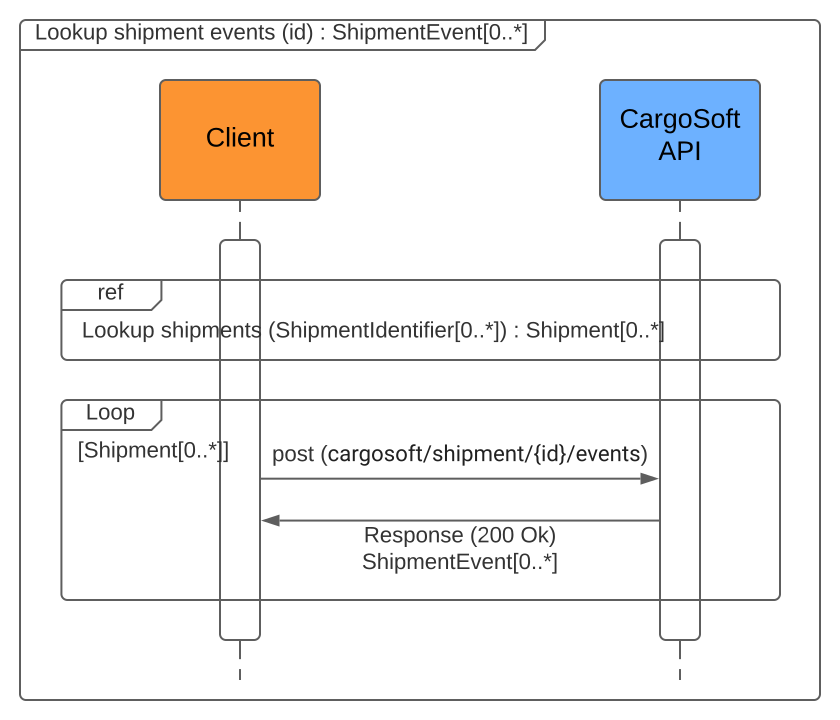
The result set of a lookup includes zero up to n functional objects depending on the search criteria. Each functional object contains an ID. The ID can be used to retrieve additional information by passing the id as a path parameter of the retrieve endpoint.
Example: Lookup a shipment and retrieve all shipment events
Most endpoints of the CargoSoft API use pagination mechanics.
The pagination information will be sent as a request query parameter to the API endpoint. The pagination contains the following two query parameter:
- page_no: The current number of the page
- page_size: The size of the page
Example: Lookup a shipment with pagination query parameter
curl --location --request POST 'https://api-demo.cargosoft.de/cargosoft/shipment/lookup?page_no=1&page_size=5' \
--header 'Authorization: Bearer eyJ0eXAiOiJqd3QiLCJhbGciOiJSUzI1NiJ9.eyJzdWIiOiJ1cGRhdGUiLCJjYXJnb3NvZnQtand0LNjc2NDQ1NTAzfQ.mK82rjSu0ltd0bf3mvXUqwpME05ck5OEuqnzsAQ8WPFPo' \
--header 'Content-Type: application/json' \
--data '[
    {
        "match_mode": "EQUALS",
        "key": "MBL",
        "value": "MASTER_12345"
    },
   {
        "match_mode": "EQUALS",
        "key": "MODE_OF_TRANSPORT",
        "value": "SEA"
    }
]'
The response contains two additional headers:
- X-Page-Count: The total number of pages.
- X-Row-Count: The total number of found objects.
With these both headers it is possible to scroll through a result set.
For testing purposes CargoSoft hosted a server with the last released CargoSoft API.
URL: https://api-demo.cargosoft.de
To use the test environment, please use the "Try it" console in this documentation. Login credentials are needed to use the test API. The credentials have to be requested from the CargoSoft support. The received information grants access to a test account which should be able to use all endpoints. If any endpoint is restricted, please contact CargoSoft. Please have in mind that the test environment will be reset every night!
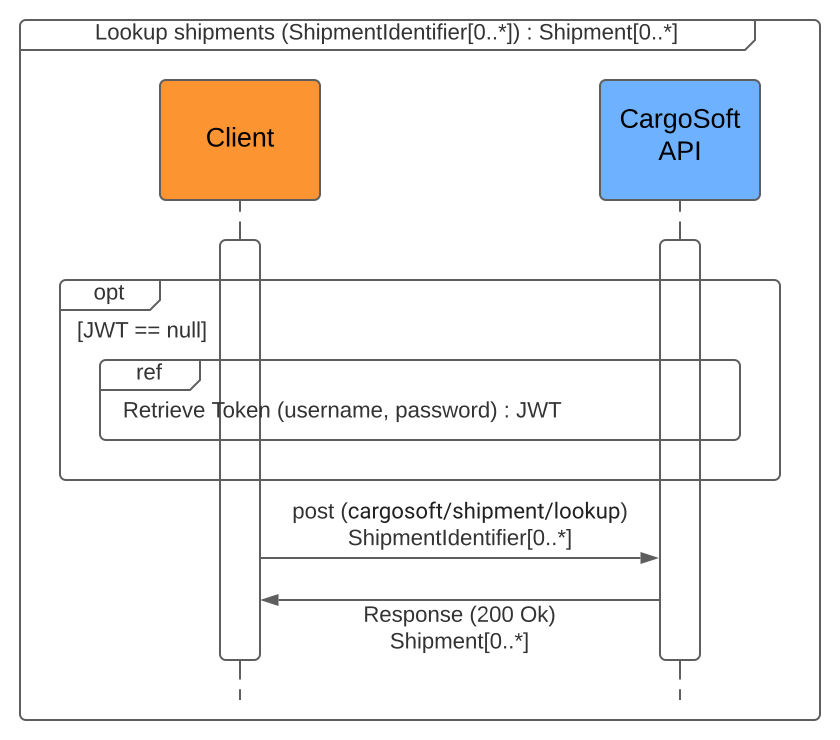
To retrieve a shipment, the lookup endpoint of the shipment functional group is one of the common possibilities that should be used. The following figure shows the use case to look up a shipment. To keep the figure simple, the authorization process is referred.
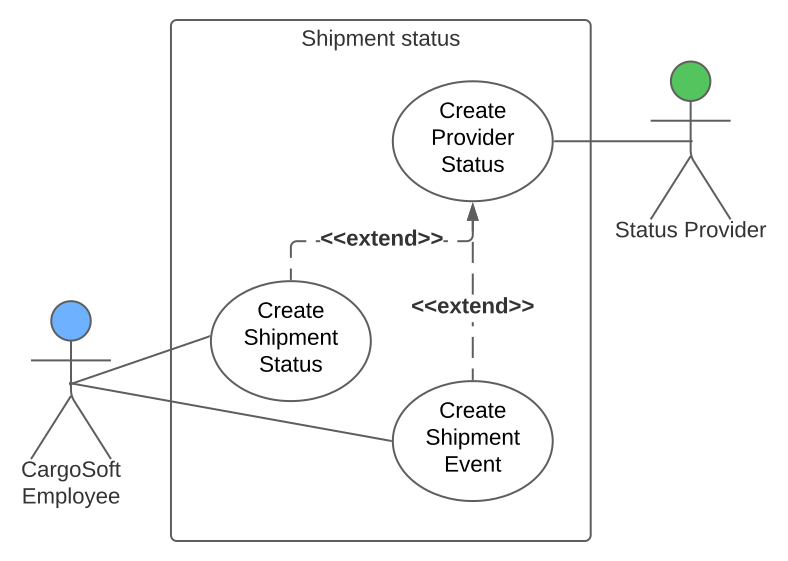
These status messages come from external status providers and service providers who supply CargoSoft with status information. They cannot be entered or changed by CargoSoft employees by hand. A shipment provider status always represents exactly one state - planned / estimated or the actual date and time (depending on the name of the status). The codes of the statuses are defined by the providers and are variable depending on the provider.
Please note: There is no endpoint to retrieve provider status from the CargoSoft API yet. This endpoint will be implemented in a later release.
CargoSoft customers can define this status code themselves. In addition, the shipment provider statuses can be mapped into a shipment status if the CargoSoft customer configured his basic data accordingly. Here, for example, it can be defined that the status ABC of provider XYZ has to be processed as shipment status ETA. In this case ETA would be a freely defined code for the status. Therefore, there is no list of valid codes.
With this status, there are also two forms of date information per data record. Once a planned and an actual one. This means that a status ETA, although obviously planned, can contain an actual date. However, this is due to the recording of the customer's data.
The CargoSoft customer can add this status information manually, but an existing record can no longer be changed.
Please note: There is no endpoint to retrieve CargoSoft status from the CargoSoft API yet. This endpoint will be implemented in a later release.
Shipment events are status events that are defined by CargoSoft. These events are fixed and can always be called up - unless there is no data available for the shipment. For a complete list of shipment event codes see here. A shipment event can be created automatically from a shipment or provider status if this is set in the CargoSoft master data. A status always represents exactly one instance - planned or actual and the information can be changed at any time by hand, but also by background processes.
To create a new shipment, the create endpoint of the shipment functional group has to be used. The following figure shows the use case to create a shipment. To keep the figure simple, the authorization process is referred.
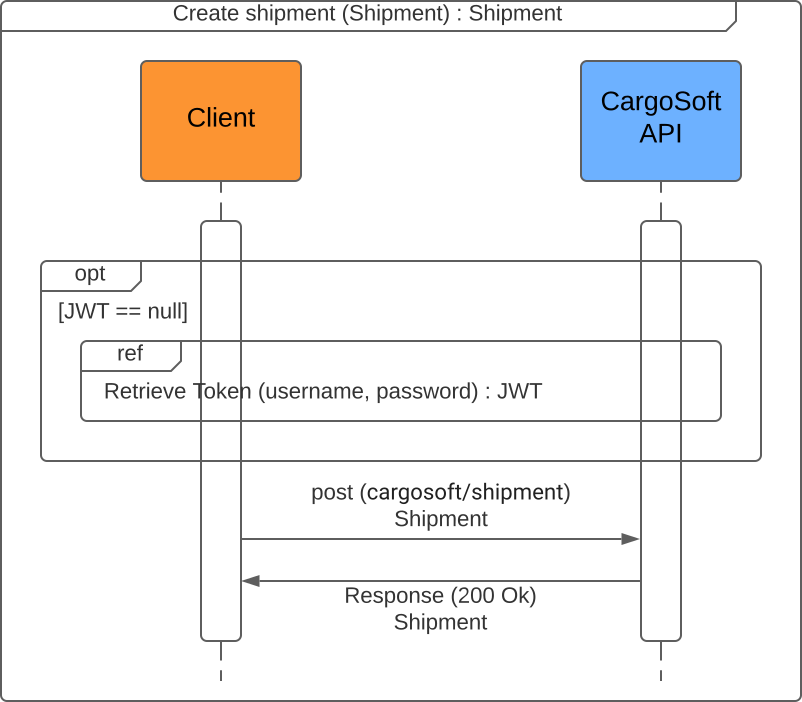
- To access the create endpoint a JWT is needed. For more details how to retrieve a JWT see.
- Based on the authenticated API user, the CargoSoft API determines the EDI partner to associate with the new shipment: the EDI partner's matchcode has to be identical to the API username. If no EDI partner exists for the API user, the request is rejected and no shipment is created.
- The determined EDI partner's settings are used, where configured, to fill in values that are otherwise required to generate the shipment number - see EDI-Partner below for the exact keys and their fallback rules.
- The shipment is created together with any nested data supplied in the same request body - goods, containers, addon field values, order memo lines, and so on. A memo text longer than the maximum line length is automatically wrapped across several consecutive memo lines - see the lookup endpoint of the shipment memo functional group to retrieve them independently afterwards. If any of that nested data fails validation (for example an addon field value referencing a matchcode that doesn't exist in the master data), the whole shipment creation is rejected and nothing is created.
- Once the shipment has been created, the shipment is returned as response to the request. The shipment response contains the unique shipment ID and the CargoSoft shipment number.
| Key | Meaning | Fallback if not configured (or blank) on the EDI partner |
|---|---|---|
SHIPMENT_NUMBER_DEFINITION_VERSION | The shipment number definition version to use. | The shipment_number_definition_version supplied in the request body, if present; otherwise the CargoSoft client's own default. |
MAINDEPARTMENT | The main department to use for shipment numbering. | The maindepartment supplied in the request body. If neither is present, the request is rejected. |
SUBDEPARTMENT | The sub department to use for shipment numbering. | The subdepartment supplied in the request body. If neither is present, the request is rejected. |
ADDRESS_FORMAT | The address format used to format the shipment addresses. | The CargoSoft client's own default in the general company parameters. |
Please note: if a request doesn't need to rely on the EDI partner's settings at all - for example while testing -
shipment_number_definition_version,maindepartmentandsubdepartmentcan simply be supplied directly in the request body instead.
An EDI code conversion translates an EDI partner's own code (for example for a charge type or packaging code) into the corresponding CargoSoft internal code, or vice versa, depending on direction. They are looked up with the lookup endpoint of the code conversion functional group, using a combination of the EDIPARTNER, DIRECTION, CODETYPE and SOURCECODE identifiers.
Two identifier combinations are served from a cache instead of querying the database on every request, since this master data changes very rarely:
EDIPARTNER+DIRECTION+CODETYPE: returns every code conversion configured for that EDI partner's table/direction.EDIPARTNER+DIRECTION+CODETYPE+SOURCECODE: returns the one specific conversion for that source code.
Omitting EDIPARTNER from a DIRECTION + CODETYPE + SOURCECODE lookup returns every matching conversion across all EDI partners that happen to share the same source code - also served from the cache. Any other identifier combination is looked up directly against the database.
Please note: the
DIRECTIONidentifier's value must be the raw single-character code as stored in the CargoSoft TMS (EorS), not thedirectionvalue (RECEIVE/SEND) shown on the response object.